News
“The movement lives on in the younger generations”
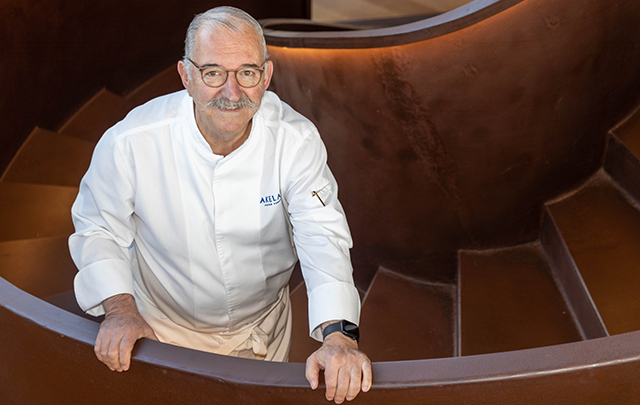
Pedro Subijana is one of the key figures in the birth of the New Basque Cuisine. Fifty years later, at the age of 77, he remains at the helm of Akelarre, and in his legendary restaurant he reflects on those early years when everything came about spontaneously yet with determination
Along with Juan Mari Arzak, Pedro Subijana was one of the leaders of the revolution. It’s impossible to say what would have become of Basque cuisine had he not embarked, alongside his friend, on that journey to Paul Bocuse’s kitchens in Lyon. At 77, he has the same energy and passion as he did in 1976. Sitting beside him and chatting is a privilege. A journey back in time to the origins of New Basque Cuisine, of which he is an indispensable part.
Where was Pedro Subijana in 1976?
I’d been in the business for almost ten years. I came here (Akelarre) in 1970, but I didn’t stay; and in 1975, when I was at Iratxe, they came looking for me because the head chef had left. I came as an employee and didn’t buy the restaurant until 1980, when the owners convinced me.
What was the ‘big bang’ of New Basque Cuisine?
The whole story began with Gourmet magazine. Back then, there was no culinary information or criticism in Spain. Chefs weren’t even talked about. But they organized what they called the First Round Table on Gastronomy at the Philips building in Madrid. They invited Paul Bocuse and Raimond Oliver. During those sessions, Juan Mari and I, who already knew each other, became friends with Bocuse.
And that’s how the famous trip to Lyon came about...
That’s right. We went to Lyon to do an internship at his restaurant. We wanted to see what was happening with Nouvelle Cuisine, and Bocuse was the “Pope” of it all. Besides being very good at his craft, he was a great communicator, affable, and open to his colleagues. He treated us like family and introduced us to the Troisgros brothers and also to Alain Chapel. Juan Mari and I watched all that and thought: we’d have to do something. The culinary scene in our area wasn’t exactly thriving at the time.
Did you go there because you thought you had to do something, or did you do something because you went there?
We hadn’t come to the conclusion that we had to do something, but we went with all the curiosity in the world to see what was going on in those kitchens. Why did you feel that the cuisine here wasn’t brilliant back then? You’d go to restaurants and all the menus were the same; the recipes weren’t being innovated. There were some very talented people who were doing it, but… the point is that when we got back, we said: let’s get a few colleagues together and see what we can do. But without any organization. In 1976, we didn’t know the word “marketing.”
Would you say it was all informal?
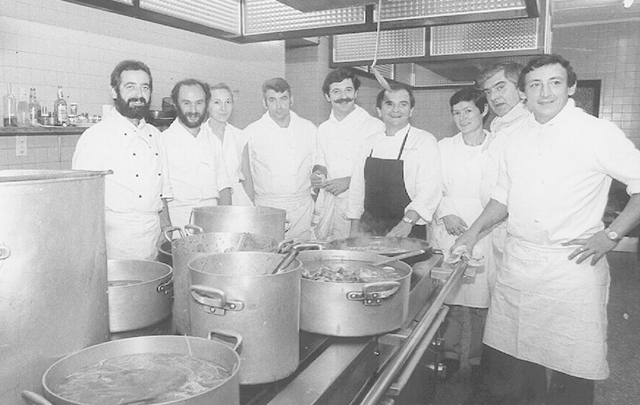
Yes. We just did it without any organization. Sometimes one group of people would get together, and other times, another. Until we formed a core group that can be summed up, more or less, by those of us who appear in the famous photo at the Muelle. But there were also gatherings with Jesús Mangas and Iza at Jaizubia, for example. The thing is, we started getting together and sharing ideas. We complemented each other.
What were those dinner meetings like?
At first it was just among ourselves, and then we started bringing in more people. To be honest, it’s hard to say exactly how many or who they were. Sometimes there were more of us, and other times fewer. We’d get together every week or every two weeks, but there was also a point when everything just dissolved without any formal procedure because we hadn’t actually founded anything. It was a bit anarchic. The thing is, we’d bring out some snacks and start talking about the foundations we were building on; we’d look to history, to historians’ books, to find out where Basque cuisine came from.
Those meals evolved...
That’s right. We decided to each invite some of our clients, and we’d prepare a meal for about 40 guests. And we immediately realized we had to share this: we invited a journalist, a pastry chef, and someone else from a different field besides cooking. I remember José Mari Gorrotxategi, such a charming character. The guests didn’t pay. We ordered the ingredients from our suppliers, and after the meal we’d go out to the dining room to explain what we’d done and why. We didn’t say who had made each dish so that no jealousy would arise.
Was that good relationship between you all key to ensuring that fierce competition didn’t arise, but rather a complementary dynamic?
There were moments for everything. Once, one of the group complained that no one was talking about him, and a journalist replied: ‘Give me a reason and I’ll talk about you. Do something; don’t just be a sidekick.’ It’s logical and normal that it’s not easy to act as a group and avoid elbowing and tripping each other up to stand out. But the truth is that whenever someone was tempted to do that, the others talked them out of it. On the other hand, we were always open to more people joining us.
People from other places also called us to ask how we’d done this, and the answer was that we didn’t have any organization or system. We’d tell them: ‘You can do this in your town. I’m sure there are wonderful things there.’
Were you aware that you were starting a revolution?
No. We didn’t realize it until it was all over. We wanted to do things and we had ideas. That’s all. But we always kept in mind that what we were doing was for the country, for our country’s culture, because we had to ensure history was preserved and we had a responsibility to add something to the legacy we had received.
How did you turn something classic into something revolutionary?
We had a clear respect for what we had inherited. And we had also inherited the good name of Basque cuisine, the result of the work of many men and women. We drew inspiration from that. We weren’t fighting to erase it—quite the opposite. We wanted to value it and ensure things were done authentically and well. We wanted it to be honest cuisine. So we had the history, the reality preserved in the moment, and we looked to the future with freedom: let everyone do their own thing as they see fit and break the rules with innovation and creativity. Sometimes innovation is misunderstood. It’s about doing something others haven’t done, not copying a little from one and a little from another to make a cocktail. You have to have sensitivity. I don’t consider myself an artist, but a craftsman, and as a craftsman there may be more artistic or innovative things, but you can’t just conjure things out of thin air. In the end, what has emerged from history is the prestige of a profession that had no prestige at all.
How did haute cuisine and Michelin-starred restaurants fit into a Basque Country immersed in a crisis of such magnitude at every level?
I think there were so many complicated issues in society that what we were doing was very clean and very positive, and that’s why the press supported us. Obviously, you have to give them a reason, but it was the promotion of a vibrant Basque Country—something positive, something good—and I think that’s why they treated us so well. I remember a headline from Cambio 16: ‘The White Revolution of the Cooking Pots.’ White for clean, because it wasn’t against anyone. That was great.
At what point did you see people start coming to the Basque Country to eat?
This was tough. People think we were born that way, but we all started from scratch and knew nothing. We faced huge difficulties because there weren’t enough people to fill the restaurants during the week. I think companies and executives held many meetings over meals, and that helped us a lot.
After the founders came Hilario Arbelaitz, Martín Berasategui, Aduriz... Did they carry on the movement?
Not only did they carry it on, but many have surpassed what we did. We have a close and fantastic relationship and do many things together. We host fellowship dinners to let them know we’re just like them, that they can ask us for anything and we’ll help because that’s what friends and colleagues are for.
Do you feel the movement is still alive in the new generations?
Yes, of course it’s still alive. I think that when you arrive at a place where things work in a certain way, you can’t just come in and tear everything down. You have to join in and contribute. I think we’ve laid the groundwork for that, and that’s one of the greatest legacies of New Basque Cuisine. That support, that collaboration, and that sense of community.
Do you see yourselves reflected in these young people? Do you share values and concerns?
Yes. It’s true that some are in a great hurry and have a lot of anxiety that we didn’t have. Perhaps the media exposure that exists today leads to an overinflated ego. This means that some rise too quickly and burn out.
Where will the next transformation in cuisine come from?
I’m anti-trends. I like to do my own thing, and I think that’s very important because we were born out of the fact that everywhere you went, you found the same cuisine. Right now, that risk is probably emerging again because you go to places and it starts to seem like everywhere is just the same old thing.
What must Basque cuisine do to remain at the top amidst so much competition?
Competition is always good, if it’s honest. I think it was Pedro Luis Uriarte who coined the term ‘coopetition,’ which means collaborating in competition. Juan Mari and I have always been a team, but we’d call each other and ask: What are you doing, what do you have, who’s there, who isn’t, have you done a good job... ‘We’re very close friends, but I want to work harder than you,’ he used to say. That spirit is good, and without realizing it, we created and invented gastronomic tourism. It meant people traveling just to go to a restaurant.
Pedro’s thoughts on…
› Juan Mari Arzak: The smartest.
› Karlos Arguiñano: A friend through and through.
› Tatus Fombellida: Our only woman, treated like one of the guys.
› Ramón Roteta: He could charm them with just a look.
› José Juan Castillo: A great character.
› Luis Irizar: The most generous, the best teacher, and a great person.
› Patxi Quintana: A ray of sunshine.
› Xabier Zapirain: Game specialist.
› Ricardo Idiakez: A hard worker through and through.
› Manolo Iza: A modern chef for his time.
› Jesús Mangas: The best host.
Photos: Unciti
Related news
News

The most maritime and experiential edition of Gastronomika celebrates half a century of New Basque Cuisine
News
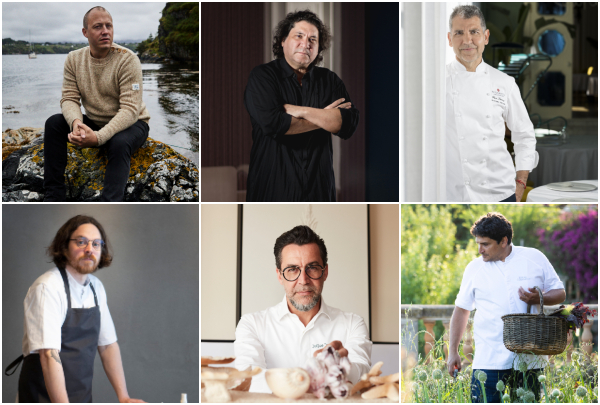
Gastronomika 2026 is broadening its international outlook by welcoming Mark Kurlansky, Mauro Colagreco, Jacopo Ticchi and Poul Andrias Ziska.
The 28th edition of the congress, which will take place from 5 to 7 October under the slogan 'The spark that lit the fire', will feature new voices as part of a programme dedicated to the 50th anniversary of New Basque Cuisine. This year will also see a global cod festival, with chefs from various countries taking part.
News
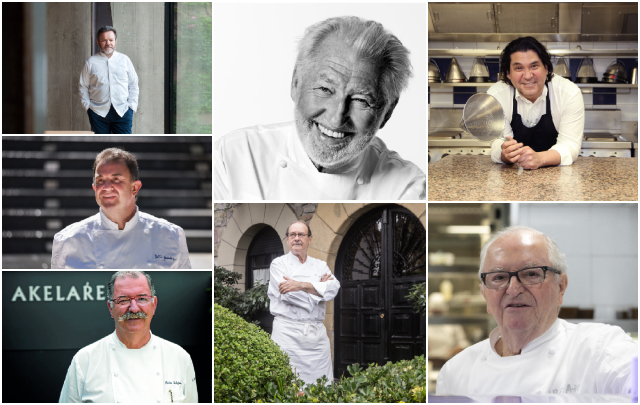
Gastronomika 2026 will pay tribute to the 50th anniversary of New Basque Cuisine
News
“The greatest value of the New Basque Cuisine was the creation of a collective culinary intelligence”
Benjamín Lana points out that during a difficult period in the Basque Country, everything changed in the kitchens, “where the good people were and those who got along best.” For this reason, he praises “the strength of the team” as the most distinctive feature of a generation that will be honored at San Sebastian Gastronomika
News